In August I wrote about evidence of a binary supermassive black hole in the center of a galaxy. Now there’s news of another binary in a different galaxy.
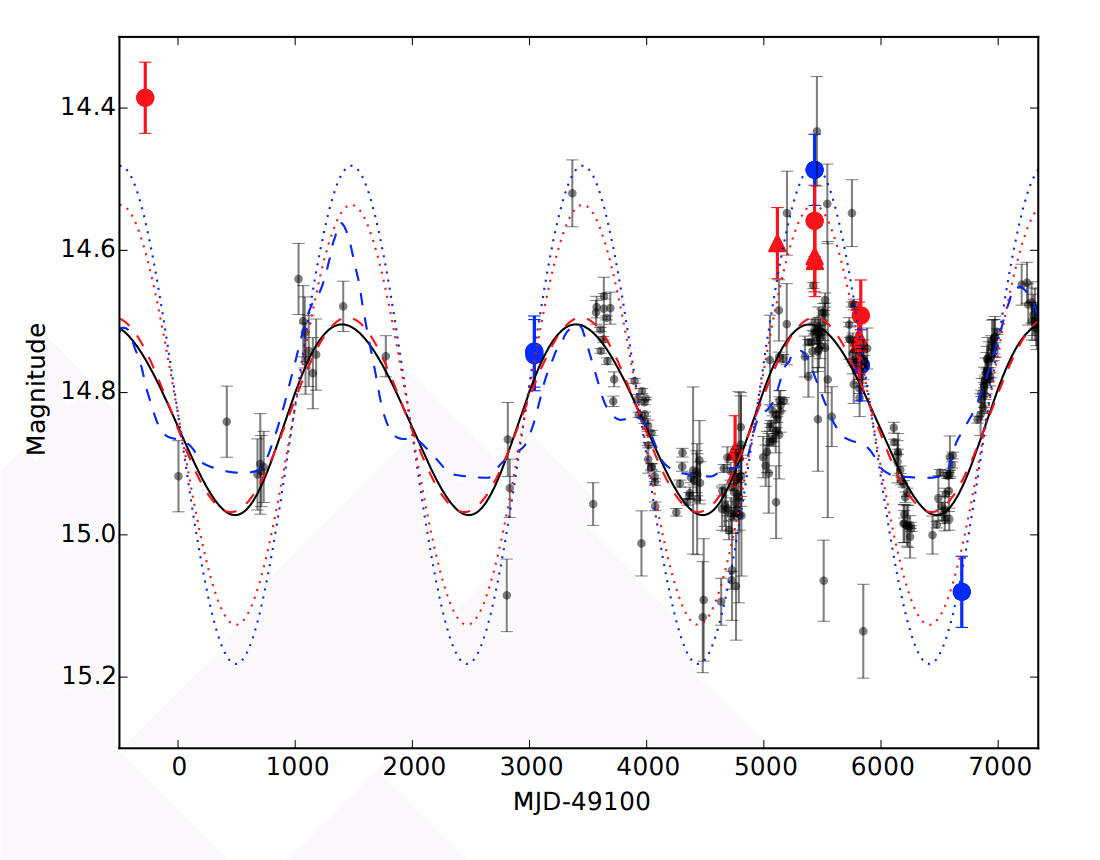
Given a period of only 5 years, the smaller black hole would need to be moving at nearly 7% of the speed of light. That’s fast enough that special relativity plays a role. If their model was correct, then there should be an even larger variation in brightness at ultraviolet wavelengths. So the team looked at archive data from GALEX and Hubble, which had observed the quasar in the ultraviolet. What they found matched their predictions. All indications are that PG 1302-102 is a supermassive binary.
What’s particularly interesting about this binary is that the two black holes are quite close, about 2,000 astronomical units apart. That’s really close given that their combined mass is on the order of a billion Suns. Within another few hundred thousand orbits, the two black holes will merge with a brilliance of 100 million supernovae.
Paper: Daniel J. D’Orazio, et al. Relativistic boost as the cause of periodicity in a massive black-hole binary candidate. Nature 525, 351–353 (2015)