Most of the planets we’ve discovered around other stars have been found using the transit method. When a planet passes in front of its star, it blocks some of the starlight, making it appear slightly dimmer. It’s a great way to discover planets, but it has some serious limitations.

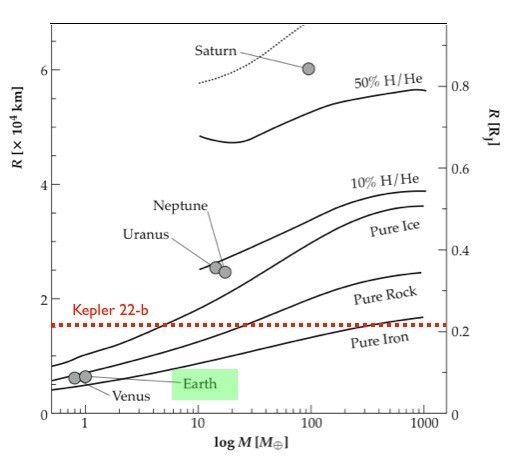
The problem is that planets with similar sizes can have very different physical characteristics. Take, for example, the exoplanet known as Kepler 22b. It’s radius is about 2.4 times that of Earth, and thus it’s a type of planet known as a “super Earth.” However its mass isn’t well known, and could vary significantly depending upon its composition. If it is mostly water and ice, it might be 3 – 5 Earth masses. If it is mostly rock, 30 – 50 Earth masses, and if it’s mostly iron its mass could be over 100 Earth masses. By comparison, the mass of Neptune is only 17 Earth masses, while Saturn is only 95 Earth masses.
Realistic estimates put Kepler 22b around 40 Earth masses, perhaps as an ocean world with a rocky iron core, which is hardly an Earth-like world.